

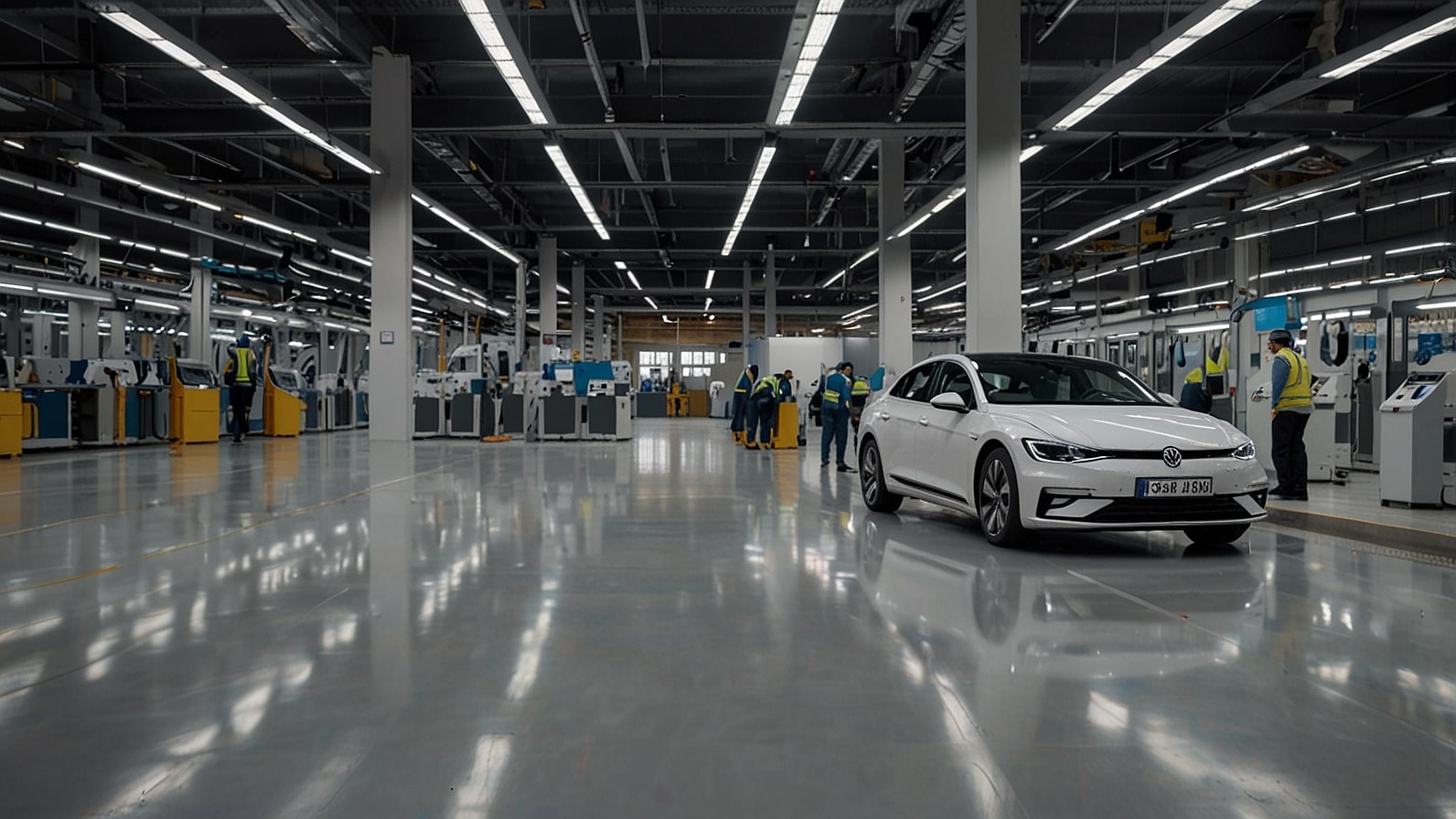
Wolfgang, in a radical step to be the first in regaining dominance in the written electric car market, Volkswagen Group has declared that it is investing EUR 10 billion to construct and develop battery manufacturing plants in Germany.
The program, which is announced today, is expected to generate 300 gigawatt-hours of battery capacity each year by 2030 to service millions of EVs and generate more than 5,000 tech-intensive jobs.
This is announced at a time when Europe struggles to manage the supply chain weaknesses and increasing competition from Asian producers. Localising battery manufacture, Volkswagen aims at cutting down the dependency on imported parts, raising sustainability, and achieve high EU green goals. It is planned to have new plants in Salzgitter and Braunschweig and expand the existing plants in Dortmund and Kassel.
Government Backing Fuels National EV Ambitions
The project is in line with the national policy of electromobility in Germany, which is backed by the federal subsidies of the European Battery Alliance. The Economy Minister Robert Habeck termed the move a game-changer in terms of the industrial heartland of the nation, highlighting that it helped in saving automotive jobs amid the transition to internal combustion engines.
The approach of Volkswagen is on vertical integration, where it controls all aspects of producing a product, such as sourcing of raw materials to cell production. The collaboration with suppliers, such as Northvolt and Umicore, will be aimed at recycling and responsible sourcing of lithium, cobalt and nickel, as well as environmental issues of the battery supply chain.
This is also applied to research facilities where the Fraunhofer Society is at the forefront of collaborating in solid-state batteries, a third-generation technology that holds a greater energy density and a higher charging rate. These innovations will be tested with pilot lines at the new facilities, which could first appear in the ID. series of VW cars in 2028.
Increasing Employment and Training in Major Industry Centres
The EUR10 billion injection will turn the conventional production areas into EV innovation hubs. The steelworks of VW already situated in Salzgitter will be home to a huge gigafactory with 2,000 workers, which will focus on the production of cathodes.
The growth of Braunschweig will contribute 1,500 jobs in anode development, according to one of the advantages produced by the location of the site, which is the proximity to the research headquarters of VW.
Such positions include engineering, automation, and data science, and VW invests EUR500 million in professional training. The company will train 10,000 employees every year in collaboration with local universities, with the priorities on battery chemistry, AI-optimised assembly, and sustainable logistics. This takes care of the impending skills shortage of green technologies in Germany, where the demand for EV specialists exceeds supply.
In addition to direct jobs, the ecosystem will trigger suppliers, logistical companies and startups. The battery plants shall establish a Battery Valley in Lower Saxony, which will draw EUR3 billion in the related investments and encourage spin-offs in energy storage on the renewables.
Sustainability at the Core: Green Batteries for a Carbon-Neutral Future
The plan will include a zero-emission blueprint of production. The plants will operate with 100 per cent renewable energy, and this will be produced in the wind and solar farms, located in the north of Germany.
New water recycling systems and artificial intelligence waste management will reduce environmental impact with the goal of achieving a 50% reduction in CO2 emissions per battery than modern standards.
Volkswagen is leading in circular economy implementation, and recycling facilities on-site reclaim 95% of the materials of end-of-life batteries. Such a closed-loop model is not only cost-cutting, but it also puts Germany at the forefront of responsible EV scaling.
The project will help the EU ban fossil-fuel vehicles by the year 2035 to make sure that the VW lineup, including small IDs and high-end Audis, will be competitive.
This is acclaimed by experts as a European industrial model. Through the incorporation of sustainability at the very core, the plants would be able to export in the form of the so-called green battery expertise to support exports and trade balances.
Winning the International Battery Race
Germany is pushing EVs: skyrocketing energy prices, geopolitical over key minerals, and stiff competition against BYD and CATL of China. The Volkswagen responds with scale and innovation with the objective of achieving cost parity with Asian competitors in 2027 by using automated gigafactories.
The investment also operates through regulatory bottlenecks, which include traceability stipulations of the passporting provisions of the forthcoming EU Battery Regulation. The VW digital twin technology will model production lines and reduce the development time and risks.
This is in the larger industry changes. As the Gigafactory Berlin of Tesla increases, the relocation of VW makes the domestic competition intense, and the rivalry is joined in the fight against external adversaries. Analysts believe it will have a battery market share of 20 per cent of the German firms by the end of the decade.
A Propensity to have a Green Mobility Europe
The pledge of Volkswagen is a shot of hope in the car industry in Germany, which has been ravaged by the recent scandals and slowdowns. It highlights the fact that the country is shifting to high-value product production, with EVs being EUR200 billion worth of revenue projections per year.
This investment will make Germany the EV powerhouse in Europe as the world speeds towards net-zero. It leaves competitors such as BMW and Mercedes with little choice but to go all in on localisation and create a battery boom on the continent.
Its spillover is worldwide: the democratisation of EVs through cheaper and greener batteries would reduce emissions in urban areas and dependence on oil. To the employees of the Ruhr Valley and elsewhere, it has become a lifeline and a laboratory for the mobility of the future.
The vision of Volkswagen is coming into form with the construction to commence next spring. The electric revolution in Germany is not only rolling on electrically, but rather defining the way to a sustainable future. It is not just infrastructure; it is the boost to the European quest to become energy self-reliant and act on climate change.
